Of Goose Quills, Gloves, and Writing Booths
(Find me at Bookers Buzz Books.)
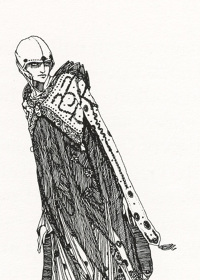
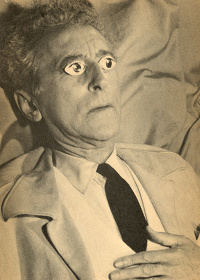
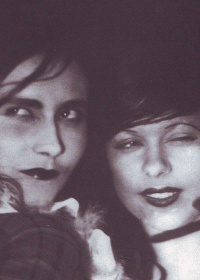
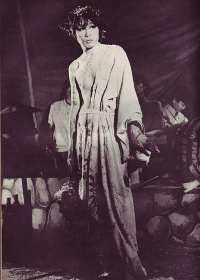
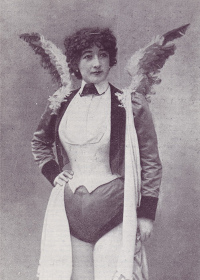
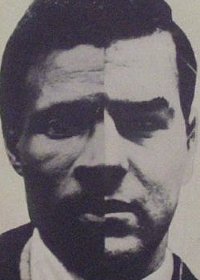
James Joyce and Edith Sitwell
A Succinct Survey of Authors' Accessories and Accoutrements
by Gilbert Alter-Gilbert
It is generally conceded that creativity can be engendered and enhanced by artificial agency. In the literary sphere, the evidence for this extra-dynamic phenomenon has taken many fascinating forms and found expression in a variety of media.
*
Perhaps the most familiar and obvious manifestations of this principle are the colorful flourishes of fashion affected by the literary class. Among the idiosyncrasies of dress setting authors apart from the crowd are any number of distinctive sartorial signatures sufficient to send the slap-happiest of haberdashers into a dither of aesthetic paroxysms. Episodic French novelist Marcel Proust, for example, had so pronounced a fondness for velveteen gloves, that he frequently wore them to bed.
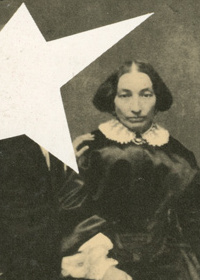
Marianne Moore and George Sand
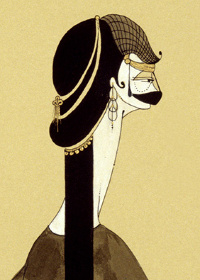
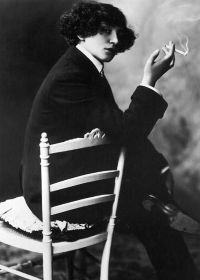
In the headgear department, American poet Marianne Moore is inseparable from the ubiquitous tricorn hat which made her look like a Minuteman hastening to Bunker Hill; Voltaire has been immortalized by his Phrygian cap, which made the Father of the Enlightenment resemble a superannuated sandman or a senile jester sprung from a broken jack-in-the-box, while Ernest Hemingway's constant cap-companion, on the other hand, was a long-billed model, designed to shade his brow while Marlin fishing. British belle-lettrist Edith Sitwell's cigarette holder made her look entirely like Edith Sitwell, which is to say, a post-Edwardian rendition of an exceptionally eccentric, decadence-dripping, slightly deranged tsarina.
Faulkner, Meyrink, Chesterton
Countryman G. K. Chesterton's opera cloak gave him the appearance of a caped crusader for the Republic of Letters and Romanian-Swiss Dada dandy Tristan Tzara was photographed so often in his youth with his Old World monocle cupped to his face that it gave the impression of being an epidermal appendage. He seems to have divested himself of this ocular appurtenance in later years, when he became a respectable burgher no longer sporting a striped gilet and a cane after the manner of a silent screen thespian circa 1922.
Tzara, his monocle, his ascot, and Rene Crevel, by Man Ray (1928)
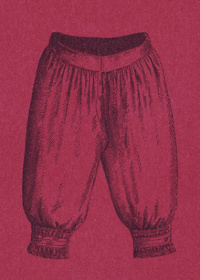
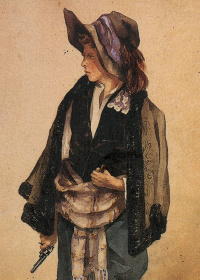
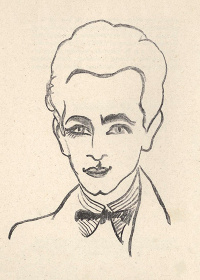
Nipponese pen-pusher Yukio Mishima's tatenokai arm band, emblem of the Shield Society, his private army, adorned his sleeve at every opportunity. Irish dramatist Oscar Wilde preferred floral ornaments—the carnation and the sunflower—as a personal metaphor, while the distinctive badge of Mississippian prose-bender William Faulkner was a simple Dunhill pipe. In a perfect blend of necessity and taste, Dublin word-sorceror James Joyce brandished a black Abbott eye patch and an ashplant cane—byproducts of declining eyesight requiring a total of twenty-five surgical operations. Mid-nineteenth century cross-dressing French authoress George Sand's breeches and riding crop caused quite a commotion at the time. Austrian fantast Gustav Meyrink, on the contrary, was the picture of a strange propriety, never to be seen in public without his pearl stick-pin-studded silk cravat and immaculate mauve canvas spats. The larger-than-life figure cut by English poet William Ernest Henley with his pegleg and crutch inspired friend R. L. Stevenson to create the character of Long John Silver in Treasure Island. Curiously, some of history's most reserved and straight-laced authors had a flair for the offbeat and the antic. Henry James couldn't resist hand buzzers and exploding cigars; George Eliot frequently resorted to an ether-soaked handkerchief; still others, in keeping with our theme of attire and its adjuncts, kept fetishistic collections of walking sticks or parasols. French diarist, dramatist and surrealist minister of propaganda Antonin Artaud devised and circulated the movement's official calling card, which read: You are looking for Surrealism — Surrealism is looking for You. The occupational costume of the Parisian existentialists was black, denoting a dutiful mourning for the sad state of the world…
Writing implements: what could play a worthier or more essential role in the life of any author? Goethe favored a humble Faber pencil; Truman Capote, who always wrote while lying in bed or reclining on a sofa, used Blackwings. Tolstoy used dipping pens and, at one point, the silver-bearded sage of the steppes was presented with an Edison electric pen—an early mimeograph or document duplicating device, but it didn't work. Gustave Flaubert enjoyed the verve of the goose quill; Virginia Woolf composed correspondence in violet ink. With the debut of the self-filling fountain pen, authors, naturally, were among the first to put the device in service: Arthur Conan Doyle used a Parker Duofold, as did Colette; Edith Wharton's instrument of choice was the Conklin, as it was for her estimable confederate-in-letters Mark Twain. The white-maned humorist was so enamored of the Conklin crescent filler that he promoted it for the manufacturer. From 1903, Twain served as a company spokesman, extolling the Conklin in an ad campaign in which he averred "I prefer it because it is a profanity saver; it cannot roll off the desk."
Twain, himself a failed inventor and gadgeteer first class, chum of Nikola Tesla, and incorrigible sucker for any sort of new-fangled contraption, took pride in being one of the very first to adopt the early typewriter. The fabled names ring with the heady romance of a bygone era: Remington, Underwood, Royal, Hermes, Olivetti, Smith-Corona, Olympia, Halda, Hammond, Sholes & Glidden. In the Remington camp were the likes of Stephen Vincent Benet, Allen Ginsberg, Hermann Hesse, Stanislaw Lem, George Orwell, H. L. Mencken, and Flannery O'Connor. The stalwart Underwood was the mainstay of many, including Gwendolyn Brooks, Charles Bukowski, Raymond Chandler, Sinclair Lewis, Carl Sandburg, Carson McCullers and Upton Sinclair.
Tennessee Williams at the typewriter (with cigarette in holder)
The refreshing modernity and streamlined simplicity of the Smith-Corona were just the ticket for e.e. cummings, Dorothy Parker, Nikki Giovanni, and T. S. Eliot. Opting for classicism were Eudora Welty, Tennessee Williams, Ring Lardner, Richard Wright, and Clifford Odets, devotees of the Royal. Patrick White used an Optima; Sylvia Plath had an Olivetti; Jack London's workhorse was a Standard Folding; Ezra Pound's was an Everest. John Steinbeck and Eugene Ionesco were Hermes owners; J. B. Priestley was well contented with his Imperial. Mickey Spillane and Richard Wilbur found their inspiration in the L.C. Smith. The list is long and turgid, although softened by the wistful scent of nostalgia.
*
Kerouac's On the Road scroll
For other authors, the typewriter and its technological relatives were made moot by unconventional writing habits. Fernando Pessoa, Charles Dickens, Lewis Carroll, Thomas Wolfe and Vladimir Nabokov wrote standing up; Nabokov used a lectern, presumably to keep lookout for errant butterflies—he was an amateur lepidopterologist. Still other noted ink slingers used index cards or pinned pages of manuscript to the wall with thumbtacks; beatnik scrivener Jack Kerouac famously indited one of his picaresque road sagas on a roll of adding machine paper systematically unfurled like a papyrus scroll.
*
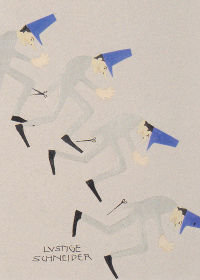
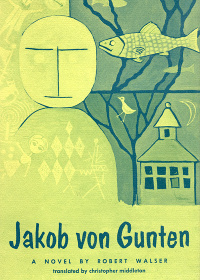
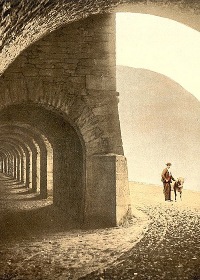
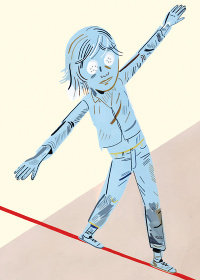
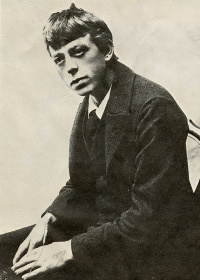
Robert Walser, out for a walk
Members of the literary set have long been noted for their enthusiasm for walking, not only for purposes of health, recreation and basic locomotion, but because this simple ambulatory activity promotes reverie and creative cogitation. Some of the world's masterpieces of the pen have had their conception in a meditative morning constitutional or a cerebral afternoon stroll. Writers have always been only too happy to quit the stuffy precincts of the garret for a breath of fresh air, and trade parchment for pavement in an outburst of joyous and unrestrained pedestrianism. And, while altogether content to be propelled strictly by the soles of the feet, writers are as likely as their forward-looking fellow citizens to avail themselves of the advantages of the latest advances in transportation. With the advent of modern vehicles such as the bicycle and the automobile, writers were as ready as anyone else to give their feet a rest, and embrace the fruits of progress.
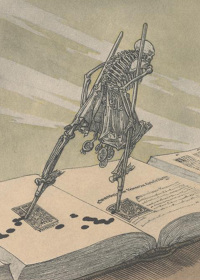
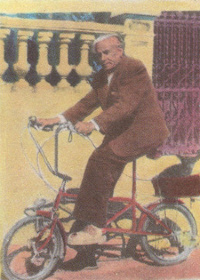
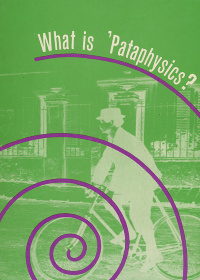
Jarry and his "external skeleton"
Pataphysician-playwright and congenital bicycle fanatic Alfred Jarry blissfully tore around the French countryside on his beloved velocipede. So obsessive was his mania for the conveyance, that he called it his "external skeleton." He adopted the dress of the racing cyclist and refused to wear any other raiment, even once attending the funeral of a famous public figure in his road regalia. He may have been a hazard on the highway, as he was a raging alcoholic, but the precise extent of his recklessness on two wheels has not been documented. Experimental French poet Francis Picabia loved fast cars and had a collection of 150; American dramatist Eugene O'Neill had the same weakness; strangest of all was Uruguayan author of grim existential narratives Horacio Quiroga, who scrambled around the fringes of the Amazon jungle on a 1925 Harley Davidson with a sidecar. The natives in the remote Misiones region on the border of Paraguay called Quiroga "el loco del moto," or "motorcycle madman."
*
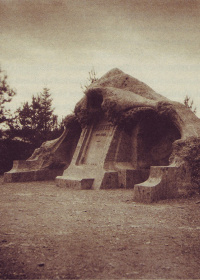
Thoor Ballylee
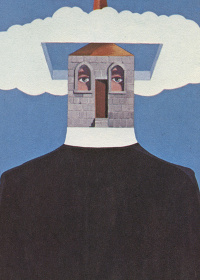
For all the convenience and prestige of a top-of-the-line bicycle or motorcar, the ultimate writer's accessory, the luxury par excellence, must surely be the personal ivory tower. "Poet's towers" have been famously occupied, in Ireland, by Rosicrucian rhymester and Golden Dawn acolyte William Butler Yeats and, in the western United States, by misanthropic poet-dramaturge Robinson Jeffers. Yeats first took up residence in Thoor Ballylee, an old stone structure in County Galway, in 1915. The ancient habitation was perfused with an ethereal fairyland energy irresistible to a Celtic Twilight twinkletoes such as himself, and he produced many significant works while cloistered within its walls. So famous has Thoor Ballylee become, as a result of its association with the redoubtable Mr. Yeats, that a miniature ceramic replica of it has been mass-manufactured by a world-renowned maker of porcelain goods, and made available as a commemorative collector's item. [The so-called "James Joyce Tower," also in Eire, is a Martello fort left over from the Napoleonic era, where the author once spent a week as a young man. Today the fort is a museum consecrated to the memory of Joyce and his writings.]
Tor House
Jeffers' Tor House, a narrow masonry cylinder of four levels he built with his own hands, over the course of several cold winters, with stones collected from the rocky shoreline of coastal Carmel, California, near Monterey Bay, still stands in all its pristine splendor. Jeffers spent much of his working life ensconced in the cramped, petrous turret, brooding about civilization and its discontents. The craving for privacy which undoubtedly underlies the urge to create such personal refuges was undoubtedly the same impetus which prodded Marcel Proust to set new precedents in environmental control with his famous cork-lined bed-chamber. A lust for Solitude and Silence, sainted twin sisters of blessed imps Sanctuary and Seclusion, spurred Connecticut Yankee Samuel Clemens to assemble a backyard gazebo behind his picturesque mansion in Hartford, where he rigidly adhered to a strict daily schedule, routinely writing and puffing his way through a a train of cigars hour after hour.
General Lew Wallace Study
In Crawfordsville, Indiana, General Lew Wallace, Civil War hero, Governor of New Mexico Territory, and author of the historical novel Ben Hur, created a habitat with just the right ambience for creative endeavor. Though he called it his "library," it is really a rather large studio, furnished with every amenity and comfort to mitigate the rigors of the writer's life. Here, Wallace could wallow in sybaritic splendor, turning his toils into something tinged with a splash of the hedonic, like a pasha taking an afternoon off from the demands of his duty to the harem.
The "James Joyce Tower"
*****
Industry has always done its dogged best to keep pace with the arts and their many-splendored vancouriers. Quick to address the needs, real or imagined, of the harried workaday writer, the titans of commerce, during decades past, have come up with mechanical paracletes, electrical aids, magnetic appliances—artificial auxiliaries and assistants of every description. Indeed, no shortage of personal afflatus aids has streamed from the restless imaginations of far-sighted inventors, designers and developmental engineers, manifest in a proud, unstinting parade of startlingly odd and offbeat contrivances. The fanciful appellations of these gadgets and apparatuses, couched in the quaint and faintly foreign-sounding nomenclature of the waning Industrial Age, are as amusing as they are colorful.
The Dictascrivener
The Patterson-Armitage Dictascrivener of 1898 was an early attempt to perfect a method of effecting transfer of thought to paper without program or mediation. The gentle voltage passing through the barrel of the Dictascrivener emitted a vibratory stimulus which would allegedly trigger a discharge of dazzling revelations.
The Dicta-pen
The Neverfail's platinum jacket, iridium tip Dicta-pen, a rival device which made its debut in 1899, was transparently derivative and unabashedly imitative of its predecessor. Accompanying literature promised to "coax veiled truths from secret places and, spontaneously dredging them to the surface from hidden depths, place them, fully formed, at the forefront of an author's faculties of awareness." Around 1904, Hammond, Hemmings, and Smith published a stunning series of Portable Literary Shrines which folded flat for easy placement in luggage and which a blockage-afflicted writer could, while traveling, unpack and set up for contemplation in a lonely hotel suite.
The Muse-o-Matic
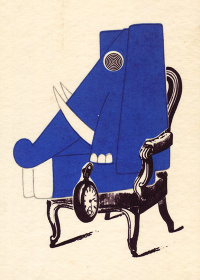
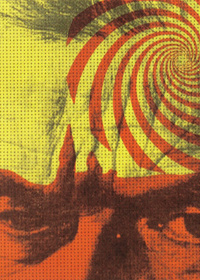
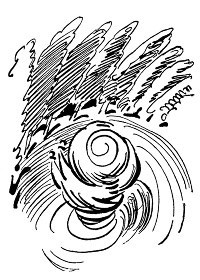
The Castalia Corporation introduced, in 1931, the Muse-O-Matic, a frightful device with a housing like that of a massive console radio ill-concealing a tangled mass of insulated wiring and cathodes and diodes galore. A nightmare of exposed hinges, argon and neon beam projectors, tubes and resistors, it was crowned by a gigantic hypnotic disk with a spiral pattern mounted on its lid. The repetitive "emanations" of the swirling spiral purportedly enabled the Muse-O-Matic to fix the user in a "thrall" of "mental captivation" induced by the machine's "invisible aura" of subtle suggestion and subliminal insinuation.
Inspiratron (interior view)
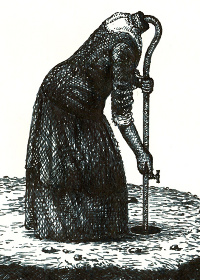
In the same year, Parnassus Enterprises followed suit with the Inspiratron, which featured a saddle with massage action, designed to soothe a spasm-fraught sacroiliac, while the writer seated thereon placed his or her hands on a pole through which a mild electric current passed. The action of this mechanism was supposed to spark an upsurge of creative consciousness.
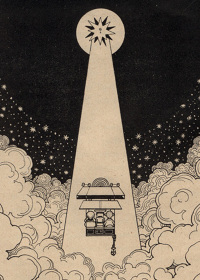
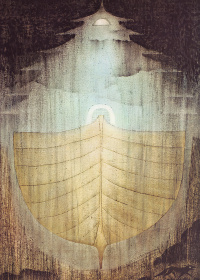
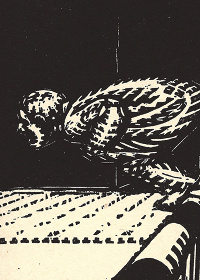
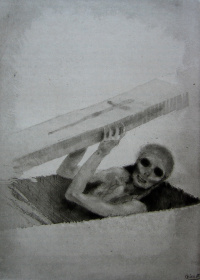
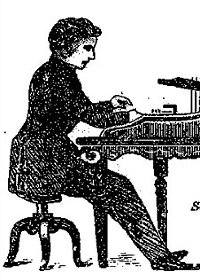
But perhaps the crowning glory of this era of rabid innovation and exploratory ferment was the invention of the personal writing booth. Towards the end of the nineteenth century, manufacturers could scarcely keep pace with demand, and cranked them out at a heady rate. Some were as colorful as carousels, others as tame as shipping crates. An extreme form of author's retreat, the writing booth was neither an elevated nor secluded edifice but a coffin-sized compartment positioned on the perpendicular and designed with the sole purpose of manifesting a perfervid inspirational influx or, to borrow from strict scientific terminology, "infrapoesis," in the subject enclosed in its confines. All writing booths had two things in common: buzzers, bells, switches and levers to pique the mind and tweak the senses; and a tight-fitting, hermetically sealed cockpit where a wishful writer squeezed into a seat which barely cleared an adjustable lap board serving as a desk. Here, the encapsulated author was expected to generate masterpieces in a condition of claustrophobic envelopment only a contortionist could find comfortable Nevertheless, many succeeded. "Immersion" could last for hours, even days. Robert Louis Stevenson is said to have penned Dr. Jekyll and Mr. Hyde while confined for a week, without emerging to eat or relieve himself!
Leading brands and models of writing booths include:
The Jones-Underhill Patent Composition Cabinet
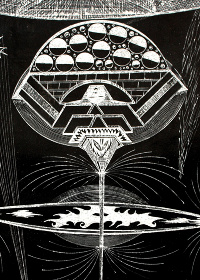
Equipped with a gleaming chromium sphere orbited by colored glass globes, the roof of the de luxe version of this cagelike structure resembled a trelliswork steeple topped by a windsock and a weather vane. This may have been because the Jones-Underhill Composition Cabinet boasted a bank of remote-controlled vacuum-intakes designed to register the "climate of the soul." Feedback from these indicators was piped into the cabinet to offer encouragement to the poet toiling within, imparting a tonic effect to a fevered brow and softening the rigors of solitary endeavor.
The Jones-Underhill Patent Composition Cabinet, alternate views (above & below)
*
General Fabricators Lucubration Closet
Restricted by a complex of obtrusive internal partitions and fitted with a nexus of acoustic baffles and riffles, G. F.'s Lucubration Closet had all the coziness of a sardine can with spikes. This forbidding cubicle was a popular and widely sold item, despite an alarming, all-enveloping intimacy not every customer found genial.
Universal Dry Goods All-Weather Field Scriptorium
This booth had the advantage of portability, even if hampered by less-than-advertised immunity to meteorological vicissitudes. Essentially a tent, its airiness gave, less than other models, the sensation of taking up residence in a dark cocoon.
Severin & Spottiswoode Spectral Dictation Chamber
Curtained like a confessional or a carnival midway photo booth and engineered for the reception of messages from the Spirit World, this legendary model is reputed to have channeled many a communiqué from the Great Beyond. Not only have great authors of the past engendered immortal manuscripts through the operations of the S. D. C. (Goethe claimed to have "received" the text of Faust by this means), they have continued to capitalize on the uncanny powers of the S. D. C. to channel transmission of fresh manuscripts after death. And, although the allegation cannot be definitively credited, it is widely believed that the practice of automatic writing was born after Andre Breton encountered an S. D. C. in a mysterious castle in the Ardennes.
Fairchild Standard Scriptomat
Its tin epidermis marvelously embellished with Doric pillars, laurel wreaths and cameo portraits of classical authors, the Fairchild Scriptomat featured a stool redolent of a refugee barber's chair from a vintage tonsorial parlor and a complex control panel checkered with pushbuttons, toggles, sliding knobs and dials.
Control Panel of the Standard Scriptomat
Pedals below and a handgrip alongside could be manipulated to regulate the fluid levels in hydraulic dispensers and release anesthetic, mood-altering gases inside the enclosure. A holdover from the pioneering days of nitrous oxide experimentation, it proved irresistible to pragmatist philosopher William James, who ordered one in hopes of curing his neurasthenia.
*
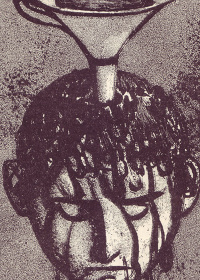
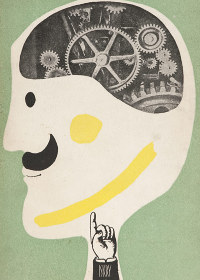
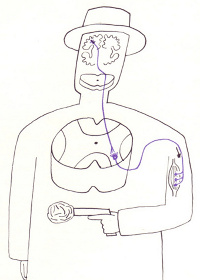
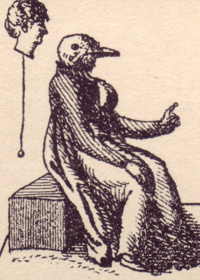
The decerebrator
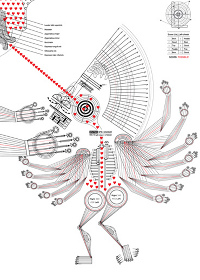
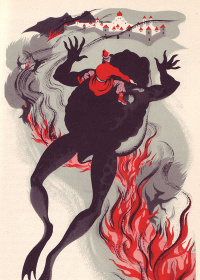
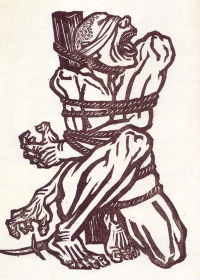
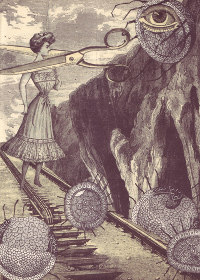
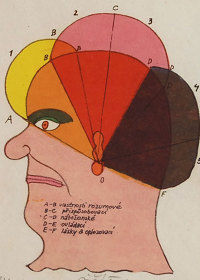
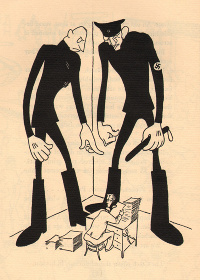
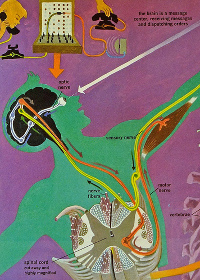
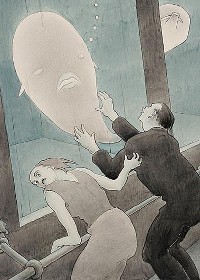
Dossiers from confidential archives have only recently come to light exposing evidence of warped applications of some of the devices outlined in the present survey. Abuses of a most glaring and infamous nature have been cited at the Institute of Noetic Sciences (popularly known as the Swiss National "Creativity Clinic") in Zurich, where clinicians are reported to have press-ganged squads of "volunteers" and subjected them to all manner of physical insults and moral indignities in the name of cultural advancement. In an outrage almost unthinkable in its implications, scores of noted European authors were, during one regrettable period, abducted by renegade elements inside the institute and strapped into electrode-studded body harnesses and counter-prevarication stirrups in an effort to force confessions of plagiarism, and other breaches of professional ethics. According to reliable sources, researchers watched expressionlessly as test subjects were infected with synthetic nerve parasites, coolly indifferent to their struggles. The extent of these horrific "studies" is not known, but the unspeakable practices in Switzerland may explain both the voluntary reclusion of several prominent fixtures in the literary firmament and the mysterious disappearance of others.
Long-buried files newly retrieved from top security vaults at the Peoples' Laboratory for Brain Research in the Central Facility for Cognitive Studies in Nulligrad, at last confirm persistent rumors that, during the early years of the Soviet regime, the notorious State Punition Bureau conducted a round of decerebrator or "brain scrambler" experiments, using controversial poets and playwrights as guinea pigs. Unfortunate participants were exposed to low frequency sound waves by means of electrodes attached to the temporal lobes. During winter nights the spastic screams of the victims could be heard piercing the arctic air as the decerebrator ratcheted into place, accompanied by the asthmatic laughter of an exultant technician leering and wheezing in a lymph-splattered smock. It quickly became apparent that the procedure had gone terribly awry when gaunt and emaciated survivors were seen bumbling about in broad daylight, addled beyond repair. Wandering aimlessly through the city streets, minds melted down to that of a mullet, they were no better than a bunch of drooling nyctophants...
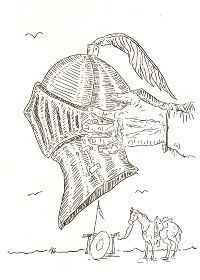
The Nooklopia Helmet
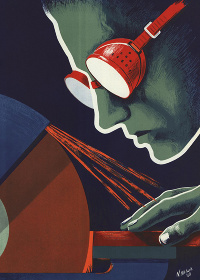
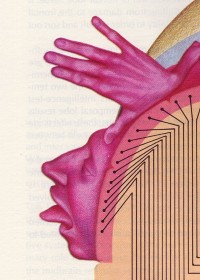
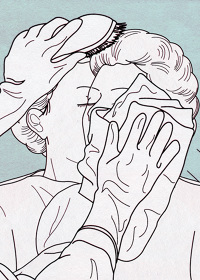
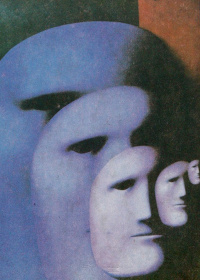
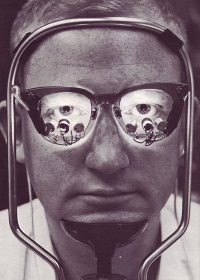
Not to be outdone by the decerebrator was the nooklopia or thought theft helmet designed to cleanse the mind of "noxious effluvia." By sucking dry impertinent ideas and erasing extraneous thought patterns from the cerebral cortex, the nooklopia helmet would theoretically free the greater cerebellum of static congestion in order to facilitate spontaneous poetic transport or "logopoesis." Clinical trials revealed a dangerous deficiency in this dubious if well-intended appurtenance—a side effect forewarned in its instruction booklet—absolute and permanent speechlessness…
Then again, no serious-minded person expects poetic exaltation to come without cost. As Arthur Koestler astutely reminds us, true creativity often starts where language ends.